
Free balance sheet template for Google Sheets
List what your business owns, what it owes and what the owner has put in, and the sheet builds a standard balance sheet for four dates side by side. A check row tells you if it balances, a ratios tab shows how healthy the numbers are, and a separate tab tracks your personal net worth.
Pro Want a printable statement, a personal version and ratios that explain themselves? See Balance Sheet Pro →| Line item | Dec 31, 2025 | Mar 31, 2026 | Jun 30, 2026 | Sep 30, 2026 | Change this quarter |
|---|---|---|---|---|---|
| Cash in bank | $18,450.00 | $12,300.00 | $27,800.00 | $34,150.00 | $6,350.00 |
| Accounts receivable | $6,200.00 | $4,100.00 | $11,850.00 | $9,400.00 | -$2,450.00 |
| Inventory and supplies | $3,100.00 | $5,400.00 | $4,200.00 | $3,600.00 | -$600.00 |
| Prepaid expenses | $1,800.00 | $1,350.00 | $900.00 | $450.00 | -$450.00 |
| Total current assets | $29,550.00 | $23,150.00 | $44,750.00 | $47,600.00 | $2,850.00 |
| Equipment | $42,000.00 | $42,000.00 | $48,500.00 | $48,500.00 | $0.00 |
| Vehicles | $38,000.00 | $38,000.00 | $38,000.00 | $38,000.00 | $0.00 |
| Less accumulated depreciation | -$21,500.00 | -$24,100.00 | -$26,900.00 | -$29,700.00 | -$2,800.00 |
| Total fixed assets | $58,500.00 | $55,900.00 | $59,600.00 | $56,800.00 | -$2,800.00 |
| Total assets | $88,050.00 | $79,050.00 | $104,350.00 | $104,400.00 | $50.00 |
| Accounts payable | $2,400.00 | $3,900.00 | $5,100.00 | $3,300.00 | -$1,800.00 |
| Credit cards | $1,850.00 | $3,200.00 | $2,650.00 | $1,900.00 | -$750.00 |
| Sales tax payable | $950.00 | $420.00 | $1,680.00 | $1,350.00 | -$330.00 |
| Payroll liabilities | $1,200.00 | $800.00 | $2,100.00 | $1,900.00 | -$200.00 |
| Loan payments due in 12 months | $9,600.00 | $9,600.00 | $10,800.00 | $10,800.00 | $0.00 |
| Total current liabilities | $16,000.00 | $17,920.00 | $22,330.00 | $19,250.00 | -$3,080.00 |
| Equipment loan | $14,200.00 | $12,100.00 | $15,600.00 | $13,200.00 | -$2,400.00 |
| Vehicle loan | $16,800.00 | $15,200.00 | $13,600.00 | $12,000.00 | -$1,600.00 |
| Total long-term liabilities | $31,000.00 | $27,300.00 | $29,200.00 | $25,200.00 | -$4,000.00 |
| Total liabilities | $47,000.00 | $45,220.00 | $51,530.00 | $44,450.00 | -$7,080.00 |
| Owner's investment | $25,000.00 | $25,000.00 | $25,000.00 | $25,000.00 | $0.00 |
| Retained earnings | $16,050.00 | $17,830.00 | $45,820.00 | $61,950.00 | $16,130.00 |
| Owner draws this year | $0.00 | -$9,000.00 | -$18,000.00 | -$27,000.00 | -$9,000.00 |
| Total equity | $41,050.00 | $33,830.00 | $52,820.00 | $59,950.00 | $7,130.00 |
| Total liabilities and equity | $88,050.00 | $79,050.00 | $104,350.00 | $104,400.00 | $50.00 |
| Check | Balanced | Balanced | Balanced | Balanced |
| Measure | Dec 31, 2025 | Mar 31, 2026 | Jun 30, 2026 | Sep 30, 2026 | What it tells you |
|---|---|---|---|---|---|
| Working capital | $13,550.00 | $5,230.00 | $22,420.00 | $28,350.00 | Money left to run the business if you paid every bill due this year from current assets. |
| Current ratio | 1.85 | 1.29 | 2 | 2.47 | Current assets for every $1 of bills due within a year. Higher means more breathing room. |
| Quick ratio | 1.54 | 0.92 | 1.78 | 2.26 | Same idea, counting only cash and money customers owe you. |
| Debt to equity | 1.14 | 1.34 | 0.98 | 0.74 | Dollars owed for every $1 the owner has in the business. |
| Debt to assets | 53.4% | 57.2% | 49.4% | 42.6% | Share of everything the business owns that is paid for with debt. |
| Owner's equity | $41,050.00 | $33,830.00 | $52,820.00 | $59,950.00 | What the business is worth on paper after all debts, at book value. |
| Item | Type | Jan 1, 2026 | Apr 1, 2026 | Jul 1, 2026 | Oct 1, 2026 | Change since start |
|---|---|---|---|---|---|---|
| Checking account | Asset | $3,200.00 | $2,850.00 | $3,400.00 | $3,100.00 | -$100.00 |
| Savings and emergency fund | Asset | $8,500.00 | $9,400.00 | $10,100.00 | $11,300.00 | $2,800.00 |
| 401(k) | Asset | $41,200.00 | $42,900.00 | $45,800.00 | $48,100.00 | $6,900.00 |
| Roth IRA | Asset | $12,600.00 | $13,200.00 | $14,400.00 | $15,100.00 | $2,500.00 |
| Home (estimated value) | Asset | $315,000.00 | $318,000.00 | $322,000.00 | $321,000.00 | $6,000.00 |
| Car (estimated value) | Asset | $17,500.00 | $16,800.00 | $16,200.00 | $15,500.00 | -$2,000.00 |
| Other assets | Asset | $2,500.00 | $2,500.00 | $2,500.00 | $2,500.00 | $0.00 |
| Mortgage | Debt | $246,800.00 | $245,100.00 | $243,400.00 | $241,600.00 | -$5,200.00 |
| Car loan | Debt | $12,900.00 | $11,700.00 | $10,500.00 | $9,300.00 | -$3,600.00 |
| Credit cards | Debt | $4,600.00 | $3,900.00 | $3,100.00 | $2,200.00 | -$2,400.00 |
| Student loan | Debt | $18,400.00 | $17,900.00 | $17,400.00 | $16,900.00 | -$1,500.00 |
| Other debts | Debt | $0.00 | $0.00 | $0.00 | $0.00 | $0.00 |
| Total assets | $400,500.00 | $405,650.00 | $414,400.00 | $416,600.00 | $16,100.00 | |
| Total debts | $282,700.00 | $278,600.00 | $274,400.00 | $270,000.00 | -$12,700.00 | |
| Net worth | $117,800.00 | $127,050.00 | $140,000.00 | $146,600.00 | $28,800.00 | |
| Change since last date | $9,250.00 | $12,950.00 | $6,600.00 | |||
| Debt as a share of assets | 70.6% | 68.7% | 66.2% | 64.8% |
What's inside
- A standard balance sheet layout: current and fixed assets, current and long-term liabilities, and owner's equity
- Four dates side by side, like quarter ends, plus the change since the last one
- A check row that says Balanced when assets equal liabilities plus equity, or shows how far off it is
- Working capital, current ratio, quick ratio, debt to equity and debt to assets for every date, with a plain note on what each means
- A personal net worth tab for your own assets and debts, with net worth over time
- Works in Google Sheets and Excel
How to use it
Download your copy
Click "Free download" to save the .xlsx file. It opens in Excel, or in Google Sheets: open a blank sheet (sheets.new) and choose File, then Import, then Upload.
Set your dates
Rename the date headers to the dates you want to report on. Quarter ends or year ends work well. Each column is a snapshot of one day.
Enter assets and liabilities
Replace the sample numbers with your balances on each date. Use your bank statements, your list of unpaid invoices and bills, and your loan statements. Enter accumulated depreciation and owner draws as negative numbers.
Enter equity and check the balance
Fill in the owner's investment and retained earnings. If the Check row doesn't say Balanced, something is missing or entered twice. Your bookkeeping or your accountant can supply the retained earnings figure.
Read the ratios
The Ratios tab works out the common health measures for each date. Watch how they move from one date to the next more than any single number.
Track your own net worth
For personal finances, use the Personal Net Worth tab. List what you own and what you owe on each date, and the sheet shows your net worth and how it's changing.
Tips
Current means within a year
Current assets turn into cash within 12 months, like cash, invoices and stock. Current liabilities are due within 12 months, including this year's share of any loan.
Use the same day every time
A balance sheet is a snapshot. Pick the same point each period, like the last day of the quarter, so the changes mean something.
Value things honestly
Use what you paid for equipment minus depreciation, and a realistic estimate for a home or car on the personal tab. Optimistic values make net worth look better than it is.
Get help with the hard parts
Depreciation and retained earnings follow accounting rules that depend on your business. For a balance sheet a lender or investor will see, have an accountant check it.
Questions
What is a balance sheet?
It's a snapshot of what a business owns (assets), what it owes (liabilities) and what's left for the owners (equity) on one date. Assets always equal liabilities plus equity, which is why it's called a balance sheet.
What's the difference between a balance sheet and a profit and loss statement?
A profit and loss statement shows what you earned and spent over a period, like a month. A balance sheet shows where things stand on a single day. You need both to see the full picture.
Why doesn't my balance sheet balance?
Usually something is missing, like a loan or a credit card, or retained earnings are out of date. Check each line against its statement. The Check row shows the gap so you know how much to look for.
Can I use it for my personal finances?
Yes. The Personal Net Worth tab is a personal balance sheet: your assets minus your debts is your net worth. It skips business items like receivables and equity.
What is a good current ratio?
It depends on the industry, so there isn't one right number. Above 1 means you have more current assets than bills due within a year. Compare your own numbers over time, or ask your accountant what's normal for your field.
Is this template free?
Yes. Download the .xlsx file and open it in Excel or Google Sheets. No sign-up needed.
Pro version
Balance Sheet Pro
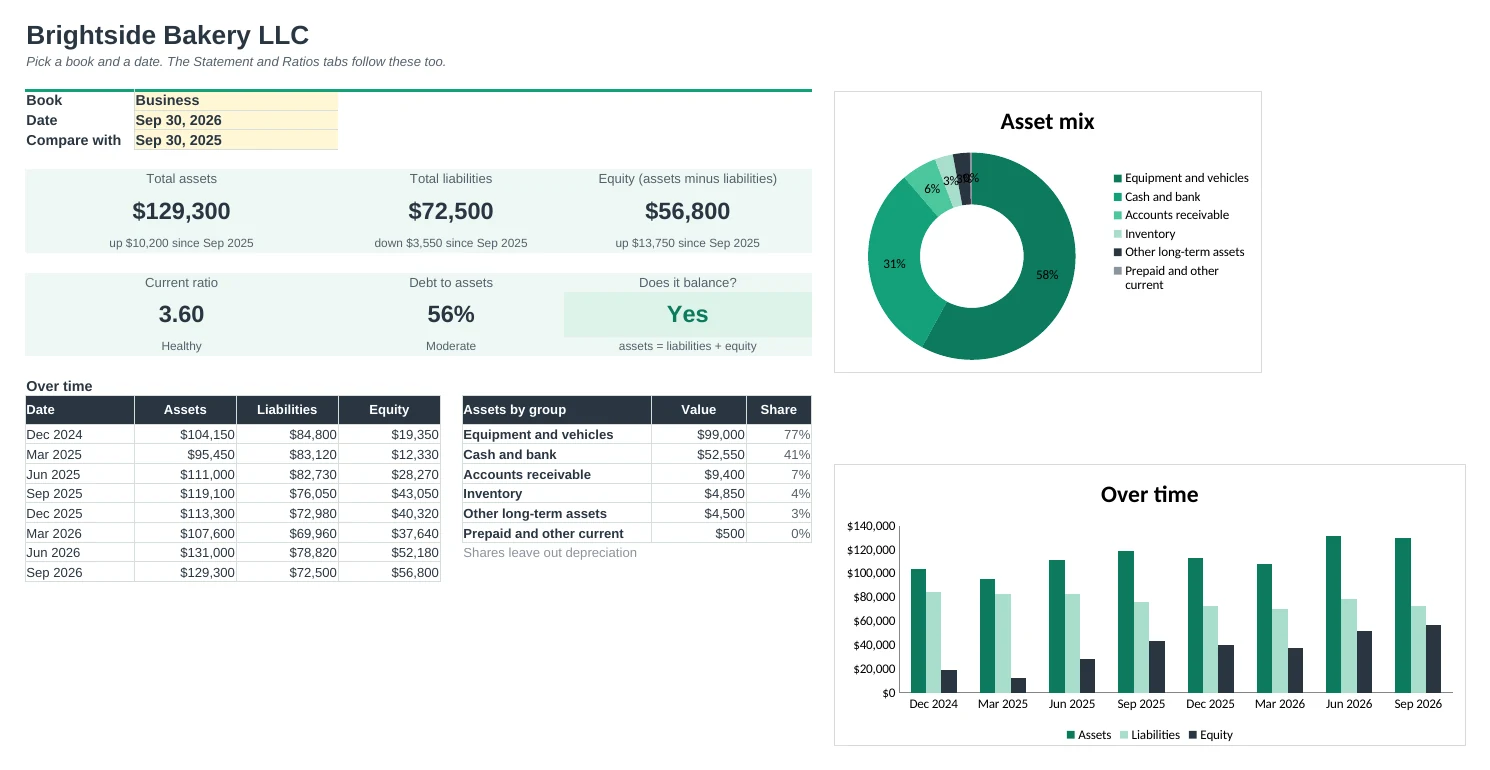
A business balance sheet and a personal financial statement in one file, with ratios explained in plain words.
Business and personal in one place
Keep your business balance sheet and your own net worth side by side, on the same dates. Switch between them with one dropdown.
Type each value once
List each account or item with its group and its value on each date. The Statement, Ratios, Trend and Dashboard all work from that one list.
A statement ready to print
Pick a date and a date to compare. Every line sits under its group with subtotals, the change in dollars and percent, and its share of the total. It fits on one page.
Ratios in plain words
Current ratio, quick ratio, debt to equity, months of spending covered and more, each with a sentence that says what it means and a Healthy, Tight or Watch reading.
Know when it doesn't balance
A check line shows whether assets equal liabilities plus equity. If they don't, it tells you by how much and what retained earnings would make it balance.
See the trend
Up to 12 dates side by side, any spacing you like, with charts of assets, debts, business equity and personal net worth over time.
| Free | Pro |
|---|---|
| Four dates | Up to 12 dates, any spacing |
| Fixed line items | Your own line items and groups |
| Balance check | Balance check with a hint when it's off |
| Ratios with a short note | Ratios for every date, explained in plain words |
| Personal net worth tab | Full personal financial statement |
| · | Printable statement with subtotals and changes |
| · | Dashboard with pickers and charts |
| · | Trend tab for both books |
$19 one-time
7 tabs: Start Here, Dashboard, Balances, Statement, Ratios, Trend and Setup. You get two copies: one filled in with a sample bakery and its owner so you can see it working, and a blank one ready for your own numbers.
Get Balance Sheet Pro for $19- Instant download after checkout
- Works in Google Sheets and Excel
- Yours to keep and reuse every year